
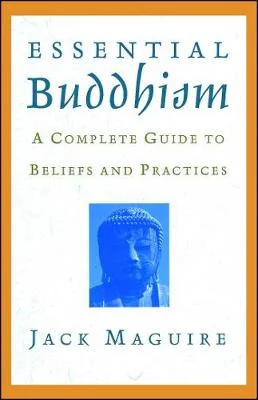
Description
By (author) Maguire Jack
Short /annotation
A fully comprehensive and throughly researched guide to one of the oldest and least understood religions in the world.
Four hundred million people call themselves Buddhists today. Yet most Westerners know little about this powerful, Eastern-spawned faith. How did it begin? What do its adherents believe? Why are so many Westerners drawn to it? ESSENTIAL BUDDHISM responds to these questions and many more, offering an accessible, global perspective on the religion”s past, present, and future. It identifies how the principal concepts and practices originated and evolved through diverse cultural adaptations into three basic formats. ESSENTIAL BUDDHISM is the single best resource for the novice and the expert alike, exploring the depths of Buddhism”s popularity and illuminating its tenets and its sensible approach to living.
Biographical note
Jack Hosho Maguire took his Buddhist vows in 1996 at the Mountains and Rivers Order of Zen Mountain Monastery, one of America”s leading Buddhist institutions. He has been a professional storyteller, specializing in Buddhist tales, for the past fifteen years. He has written many books, including The Power of Personal Storytelling, and he is a frequent contributor to the Buddhist journal Mountain Record, among others.
Excerpt
Chapter One: The Great Awakening: The Buddha and His Legacy
You are your only master.
Who else?
Subdue yourself,
And discover your master.
?the Buddha
One evening, soon after the Buddha”s enlightenment, a man named Dona was walking down a rural road in northern India when he saw the Buddha walking toward him. Dona knew nothing about the Buddha but was nevertheless struck by the radiance surrounding this individual. I”ve never seen a mortal being look so joyful and serene, he thought, so when the Buddha came close enough to converse, Dona couldn”t resist asking, “Are you, by chance, a spirit?”
“No,” said the Buddha.
“Then are you an angel?” asked Dona.
“No,” said the Buddha.
“Are you, perhaps, a god?” asked Dona.
“No,” said the Buddha.
“Well, what are you?” asked Dona.
The Buddha replied, “I am awake.”
A fundamental part of Buddhism”s appeal to billions of people over the past two and half millennia is the fact that its central figure, commonly referred to by the title “Buddha,” was not a god, or a special kind of spiritual being, or even a prophet or an emissary of one. On the contrary, he was a human being like the rest of us who quite simply woke up to full aliveness.
The Sanskrit word buddha means “the awakened one” and derives etymologically from the same Indo-European root that gives us the English word bud. In a sense, the Buddha was a sentient being who managed to bud and then bloom into total consciousness of his nature, or, to use a more traditional expression, into enlightenment. The amazing truth of the matter is that we are all potential buddhas, perfect and complete right at this moment, but very few of us realize it.
The historical Buddha”s awakening may have been a simple accomplishment,
but it wasn”t an easy one. It took him many years — and, according to strict Buddhist belief, countless lifetimes — of single-minded endeavor before he finally achieved it. Nevertheless, once he did, he claimed that any individual could do the same thing: that is, realize his or her own “buddha nature,” as it came to be called in the Mahayana tradition. He devoted the rest of his life to teaching the way.
Buddhism is therefore a religion centered around a teacher instead of a divine being. As such, it can be said to feature lessons rather than creeds, precepts rather than commandments, and rev




Reviews
There are no reviews yet.