
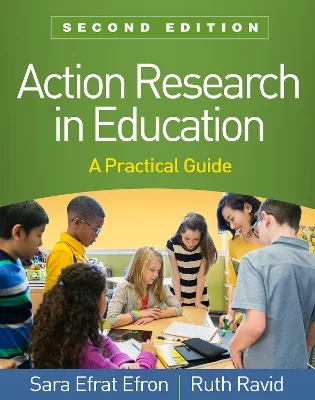
Description
By (author) Efron Sara Efrat; By (author) Ravid Ruth
Short /annotation:
Acclaimed as a text and professional development tool, this user-friendly resource has now been revised and updated, and offers expanded coverage of collaborative action research (CAR) and participatory action research (PAR).
:
Acclaimed as a text and professional development tool, this user-friendly resource has now been revised and updated, and offers expanded coverage of collaborative action research (CAR) and participatory action research (PAR). Preservice and inservice educators get crucial step-by-step guidance for conducting classroom- and school-based studies to improve their instructional practices. Organized to mirror the full cycle of action research, the book provides balanced coverage of qualitative, quantitative, and mixed methods approaches. Vivid vignettes and examples illustrate research approaches for a range of teaching and learning situations, school subjects, and age groups (PreK-12). Readers learn how research approaches are driven by the research question, as well as how to develop data collection strategies; design and/or evaluate assessment tools; interpret, analyze, report, and implement study results; and design a new cycle of research that builds on the previous one.
New to This Edition
- In-depth s of CAR and PAR–which enable groups of teachers to work together to solve problems in a classroom or school–plus examples of both throughout the book.
- Expanded or new discussions (with examples) of such topics as how research approaches and methods are driven by the research question, how to assess different types of reliability and validity, the differences between analysis and interpretation, and how to use sequential cycles of research for continuous improvement and professional development.
- Fully updated references and resources.
Pedagogical Features
- Both individual and group exercises and activities in every chapter.
- New and updated checklists and guidelines that enable busy educators to self-assess the progress and quality of their studies.
- Sample templates to assist in development of research instruments.
- Example boxes illustrating the components of an action research report.
- Summary tables highlighting key aspects of different research strategies.
- Chapter summaries (now shorter for ease of use) and suggestions for further reading.
Table of contents:
1. Introduction
2. Choosing and Learning about Your Research Topic
3. Approaches to Action Research
4. Developing a Plan of Action
5. Data Collection Tools
6. Using Assessment Data in Action Research
7. Data Analysis and Interpretation
8. Writing, Implementing, and Sharing the Research Findings
References
Author Index
Subject Index
Review quote:
“A solid overview of the essential components of action research, presented in a scholarly yet reader-friendly way. This text is excellent for our Master of Literacy program. It clearly depicts the six cyclical steps of action research, showing how research can continuously build our understanding of what works and what needs to be changed or adjusted. Unlike other action research texts that align only with qualitative research, the book discusses fundamentals of both qualitative and quantitative methods. The authors” emphasis on using the research questions to determine the research method(s) acknowledges the complexity of practitioner-based research. Practical and empowering, this book describes not only how to identify problems in educational settings, but also how to seek solutions through the cycle of research.”–Cheryl A. Kreutter, PhD, School of Education, State University of New York at Geneseo
“I used this book for




Reviews
There are no reviews yet.